

However, many small businesses still rely on free email services such as Gmail, Yahoo, or Outlook.com for business communication. These platforms work well for personal use. However, they often fall short when companies need stronger security, credibility, and centralized control.
This is where email hosting services come into play.
In this guide, we explain the difference between personal email and email hosting. We also show why a domain-based email solution is essential for growing companies, agencies, and e-commerce businesses.
What Is Personal Email?
Personal email refers to accounts created through free email providers such as Gmail, Yahoo Mail, or Outlook.com.
Examples include:
- yourcompany@gmail.com
- yourname@yahoo.com
- businesssupport@hotmail.com
These free email accounts are easy to create and convenient for personal communication. They usually provide basic features like inbox management, spam filtering, and cloud storage.
For individual users, these services work perfectly fine. But when businesses start using them to handle important emails, problems can begin to appear.
Limitations of Free Email for Businesses
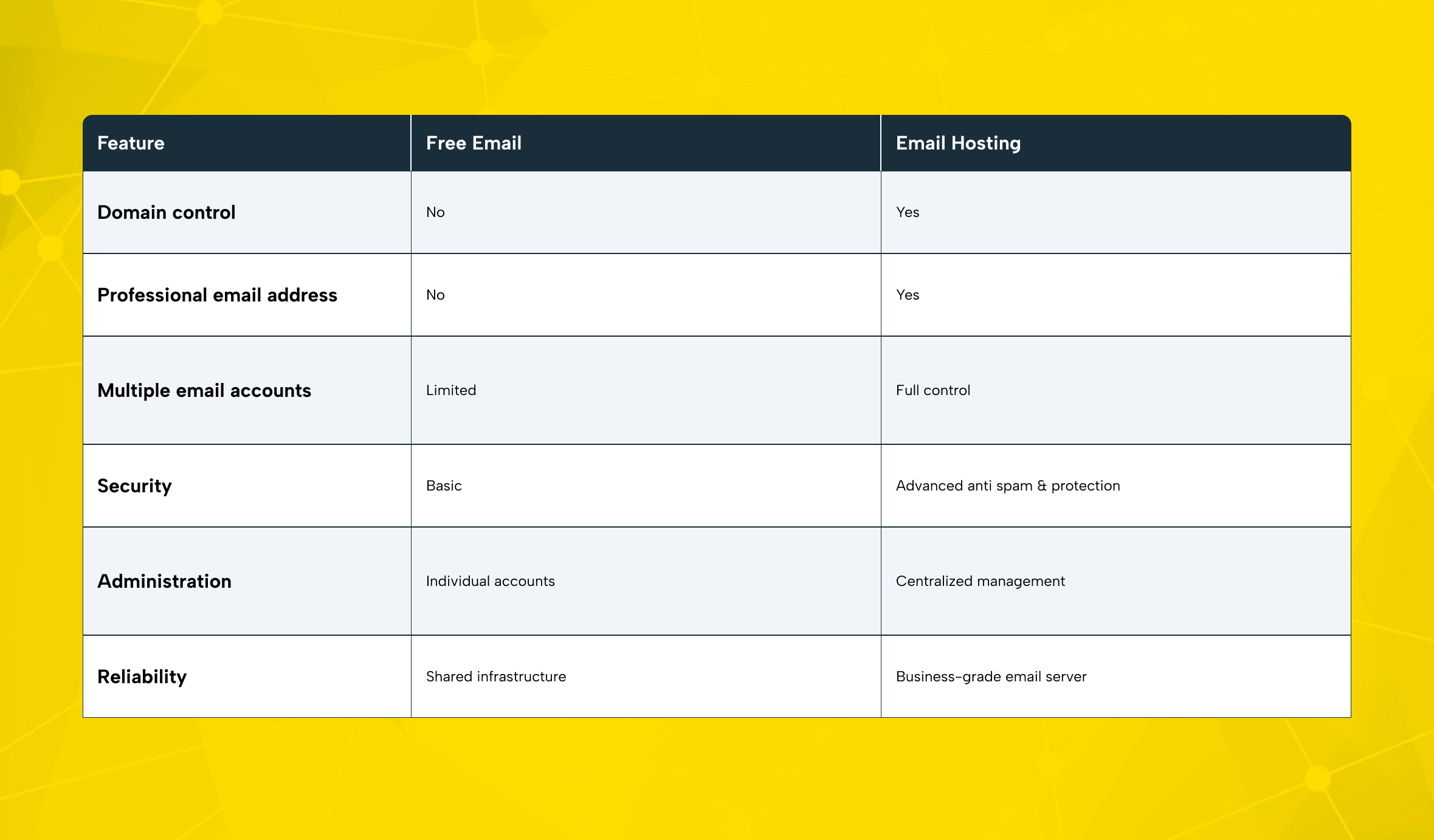
While free email platforms are useful, they were never designed to serve as a full email solution for businesses.
Here are some common limitations.
Lack of Professional Image
A business sending emails from free email addresses may appear less trustworthy to customers.
For example:
- info@companyname.com → professional email address
- companysupport@gmail.com → free email
A professional email address using custom domains immediately improves brand credibility.
Limited Control Over Email Accounts
When companies rely on free email services, managing multiple employees and departments becomes difficult.
You cannot easily control:
- employee access
- centralized administration
- mailbox policies
- ownership of email accounts
With email hosting services, businesses can create and manage multiple email accounts under one domain.
Security Risks
Free email providers offer basic protection, but businesses often require stronger safeguards.
Professional email hosting options typically include:
- advanced anti spam filtering
- malware scanning
- encrypted connections
- backup and recovery features
These protections are essential when dealing with important emails, contracts, and customer data.
What Is Email Hosting?
Email hosting is a service that allows businesses to create and manage email addresses using their own domain.
Instead of using free email services, companies use a dedicated email server. An email hosting provider provides this server.
For example:
- info@yourcompany.com
- sales@yourcompany.com
- support@yourcompany.com
We call these custom domain-based email addresses.
A proper email hosting plan allows organizations to create multiple mailboxes, manage storage, and maintain professional communication.
Key Advantages of Email Hosting for Businesses
Businesses that switch from free email to email hosting services gain several important advantages.
Professional Brand Identity
Using a custom email address associated with your company’s domain builds credibility.
Customers are more likely to trust emails from:
support@company.com
than from:
companysupport@gmail.com
A professional email address signals that the business is legitimate and established.
Better Security and Data Protection
Business email systems usually include advanced anti spam technology and additional security layers.
This helps protect against:
- phishing attempts
- malware attachments
- spam campaigns
- unauthorized account access
Many email hosting plans including security features also provide backup systems to prevent data loss.
Centralized Email Management
With email hosting services, administrators can manage all email accounts from a single control panel.
This allows companies to:
- create new mailboxes instantly
- disable accounts when employees leave
- manage shared department inboxes
- configure storage and policies
This type of centralized management is essential for small businesses as they grow.
Improved Reliability and Uptime
Professional email infrastructure is designed for reliability.
Many enterprise providers advertise a 99.9 uptime guarantee for their email platforms. This ensures that businesses can send and receive messages without interruptions.
Reliable infrastructure is especially important when businesses depend on email for sales, support, and operations.
Technical Box: Email Hosting Setup Basics
To activate a domain based email system, several DNS and infrastructure components must be configured.
The most common ones include:
MX Records: Direct incoming emails to the correct email server.
SPF Records: Help prevent email spoofing by defining authorized senders.
DKIM: Adds cryptographic signatures to outgoing emails to verify authenticity.
DMARC: Protects your domain from phishing attacks and improves email deliverability.
Modern email hosting services usually automate these configurations, making deployment simple even for non-technical teams.
When Businesses Should Switch to Email Hosting
Many organizations start with free email and later migrate to a professional system.
The most common signs that it's time to switch include:
- Growing team size
- Customer-facing communication
- Increased security requirements
- Brand reputation concerns
- Managing multiple email accounts
At this stage, companies usually move to a custom domain based email environment.
How Makdos Email Hosting Helps Businesses
Makdos provides reliable email hosting services designed for companies that need professional communication infrastructure.
The platform includes features such as:
- professional business email address creation
- support for custom domains
- secure email server infrastructure
- advanced anti spam filtering
- backup and recovery systems
- flexible email hosting options
- 24/7 customer support
Makdos also offers plans with scalable storage and mailbox management. This allows businesses to grow their email infrastructure without changing providers.
For organizations already using web hosting, integrating email hosting into their existing environment can simplify operations.
A Note for Businesses Sending Marketing Emails in Türkiye
Using a business email address is essential for professional communication. However, companies that send commercial email campaigns must also comply with regulations.
In Türkiye, IYS (Message Management System) regulates marketing emails.
Businesses that plan to send promotional campaigns must manage customer consent properly. They should also record and respect communication permissions.
This information is for general awareness and does not constitute legal advice.
Conclusion
Free email accounts may be suitable for personal communication, but businesses require more reliable and professional solutions.
By adopting email hosting, companies gain:
- A professional email address
- Better security for important emails
- Centralized account management
- Reliable email infrastructure
Domain-based email hosting helps businesses build a more trustworthy digital presence.
Makdos email hosting services provide the infrastructure businesses need to manage communication securely and professionally.