

The service makes daily management easier. It helps users handle routine tasks more smoothly. It helps teams handle routine tasks with less effort. It helps teams handle routine tasks more easily.
For many businesses, the first real hosting decision is not about buying the biggest infrastructure. It is about choosing a stable starting point that keeps the website online, manageable, and affordable. That is exactly where shared hosting enters the picture.
The reason shared hosting remains popular is simple. It lowers the barrier to entry. You do not need to configure a server from scratch or hire a systems administrator at the beginning.
You do not need to spend heavily before testing your website, content strategy, or digital sales model. You get a usable hosting plan, a familiar interface, and the core tools needed to publish quickly.
At the same time, shared hosting is not the right answer for every workload. With the right setup, business websites, online stores, and WordPress sites can perform well. A fast-growing application with traffic that changes suddenly usually needs more isolation, more flexibility, and more control.

What Is Shared Hosting and Why Does It Matter?
Shared hosting is a web hosting model that uses one physical server for multiple hosting accounts. Each account runs on the same server environment. In other words, the same server hosts website files, databases, and related services for many customers.
At the same time, each account remains separate from the others. This helps keep accounts isolated within the same server environment. In shared hosting, each website has its own storage, bandwidth, and account access. However, multiple users share the same CPU and RAM resources.
This structure makes shared hosting one of the most affordable entry points in the market. A business does not pay for an entire machine. Instead, server costs are shared across many accounts.
This makes the service more affordable for each user and lowers the cost per account. This helps keep hosting more affordable for each user. That is why startups, local businesses, content sites, and corporate websites often choose shared hosting first.
The practical importance of shared hosting is not only pricing. It also reduces overall complexity. This makes the setup easier to manage.
Your web host handles system updates, monitoring, and the backend work needed to keep the service running. For non-technical teams, that simplicity directly improves user experience on the management side.
How Shared Hosting Works
To understand shared hosting, picture a powerful machine that hosts multiple websites at the same time. The provider configures the server so each account has its own directory structure and database access. It also gives each account its own email setup and login credentials. When a visitor enters your domain, the system routes that request to the right account and serves the correct content.
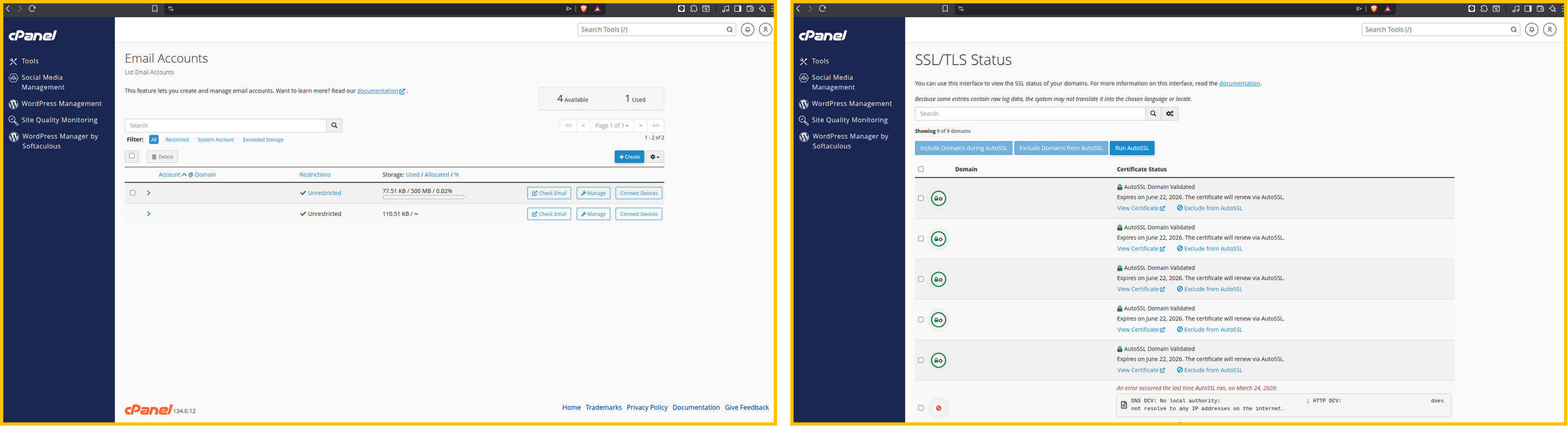
A good shared hosting service usually includes a control panel. This lets you manage daily tasks without using the command line. That means you can handle files, databases, domains, SSL certificates, email accounts, and basic settings in one place. In many setups, this happens through cPanel or a similar interface.
From an operations standpoint, a shared hosting account is built for convenience. Most businesses want the core tools included in one package. This usually includes a control panel, email, backups, database tools, and FTP access. Many providers also bundle one-click installers for WordPress and similar applications, which shortens time to launch.
The commercial side matters too. These plans may include a free SSL certificate, storage, and domain-based email. Some providers also include a free domain at signup. Since hosting offers vary, businesses should compare plans carefully instead of choosing only by the lowest monthly price.
What a shared hosting account usually includes
- An account isolated from other users at the account level
- File access through File Manager and/or ftp accounts
- MySQL or similar database support
- Domain and DNS controls inside the control panel
- SSL certificates or a free ssl certificate for HTTPS
- Email setup for branded inboxes
- Backup tools and basic resource monitoring
This is why shared hosting is often the fastest route from “idea” to “live website.”
Who Should Use Shared Hosting?
SMEs and corporate websites
For SMEs, shared hosting is often the most rational starting point. These types of websites usually do not need custom infrastructure. For these types of projects, standard hosting is often enough. In these cases, shared hosting gives the business an affordable hosting option without adding technical overhead.
Corporate brands running information-focused sites can also benefit when the workload is predictable. For service presentation, lead collection, and brand trust, a well-managed shared environment is usually enough. The key is to choose a provider with a clear upgrade path when traffic starts to rise.
Early-stage e-commerce projects
Not every store needs cloud infrastructure on day one. A smaller catalog, moderate traffic, and a controlled order volume can work well on shared hosting at the beginning. This is especially true when the store owner wants to validate demand before moving to a bigger environment.
That said, e-commerce teams should evaluate more than price. Checkout reliability, SSL certificates, backup policies, and performance consistency all affect trust and conversion. When traffic spikes, database load rises, or pages slow down, user experience can decline quickly. In that case, the infrastructure setup should be reviewed again.
Agencies, freelancers, and teams managing multiple sites
Agencies and freelancers often start with shared hosting for client microsites, landing pages, and smaller company websites. When one package hosts multiple websites efficiently, the business can reduce operating cost and keep delivery simple. As the portfolio grows, reseller hosting or VPS usually becomes a better structural choice.
Advantages of Shared Hosting
1. Lower cost and faster launch
The biggest advantage is economic efficiency. Because many customers share the same physical server, entry pricing stays accessible.
This makes shared hosting a practical option for businesses that want to get online quickly. It also helps them avoid putting too much budget in too early. This is useful before traffic and revenue are proven.
2. Easier administration
Shared hosting is designed for people who do not want to manage the underlying system. Your web host handles much of the server maintenance, while you work through a graphical interface. That reduces dependency on technical staff for everyday tasks. These tasks may include email setup, file uploads, SSL activation, and basic domain changes.
3. All-in-one day-to-day management
One reason shared hosting remains attractive is how many essentials are gathered in one place. A single account can cover web files, a database, basic email management, and security setup. That makes shared hosting service a practical fit for lean teams that want fewer moving parts.
4. Suitable for common business use cases
Shared hosting is often enough for business sites, portfolios, and content-driven projects. These types of websites usually do not require complex infrastructure. For stable uptime, controlled costs, and easy management, shared hosting is a strong fit. They often provide an efficient balance between reliability, cost, and ease of use.
Limitations of Shared Hosting
Shared resources can create performance variance
The same reason shared hosting is affordable is also where its main limitation begins. CPU, memory, and disk activity are not fully yours. If another account on the same server starts using far more resources than normal, your website may feel the impact. Providers work to reduce that risk, but the shared model cannot eliminate it entirely.
Isolation is not the same as dedicated infrastructure
Providers isolate accounts to improve safety. However, shared hosting does not provide the same level of separation and control as a private environment. For many business sites, that is acceptable. For sensitive workloads, high-traffic transactional systems, or highly customized applications, stronger isolation is often the safer path.
Flexibility and growth are limited.
Shared hosting uses a standard setup. That is a strength for usability, but a limit for advanced requirements. If your application needs custom server-level packages, unusual runtime settings, or guaranteed resource allocation, shared hosting will eventually feel restrictive.
Growth changes the equation
A website that starts small does not always stay small. If traffic and database load grow fast, shared hosting may no longer be enough. At that point, the business may need a stronger hosting setup. At that point, moving to cloud, VPS, or dedicated servers becomes a need, not a luxury.
Watch for these upgrade signals
- Admin pages become noticeably slower
- Peak campaigns create unstable load times
- Database-heavy pages start timing out
- You need more server control.
- Several teams or applications compete for the same account resources
When those signs appear consistently, it is time to compare more advanced environments.
Shared Hosting vs Other Hosting Types
Shared hosting vs cloud servers
If predictable traffic and ease of use matter most, shared hosting is usually the simpler path. But cloud servers are a better fit when the project needs flexible resource scaling. They are also more suitable when you need stronger control or better handling of sudden demand. For e-commerce brands and growth-stage businesses, cloud can become the more resilient long-term model.
Shared hosting vs reseller hosting
Reseller hosting still runs on a shared hosting foundation. However, it is designed for people who need to manage separate hosting accounts under one broader package.
That makes it useful for agencies or freelancers managing client work. If you only need one or a few websites, standard shared hosting is typically enough. If client separation matters, reseller is more appropriate.
Shared hosting vs VPS
A VPS gives you more isolated resources and deeper administrative control. It is the logical next step when a website needs more predictable performance than a shared server can offer. At the same time, it may still not need a fully dedicated machine. For scaling businesses, VPS often becomes the bridge between entry-level hosting and larger infrastructure.
Shared hosting vs dedicated server hosting
When a project demands maximum control, stronger isolation, and consistently high performance, dedicated server hosting becomes the better fit. Unlike shared hosting, a dedicated environment reserves the machine for a single customer. That is why dedicated servers are commonly used for high-traffic applications, larger databases, security-sensitive workloads, and demanding ecommerce systems.
A dedicated server hosting model is not automatically the best decision for every business, though. It brings higher cost and more infrastructure responsibility. The right question is not “Which is most powerful?” but “Which setup matches today’s real needs while still leaving room for growth?”
How Makdos Supports Businesses Using Shared Hosting
Makdos positions shared hosting as an accessible but professional starting point. Its web hosting services are designed to be easy to manage and budget-friendly. Its cPanel-based hosting setup supports key daily needs, including SSL, FTP, email, and backups.
For teams that want everyday simplicity, Makdos also aligns shared hosting with cPanel workflows. A good control panel helps businesses manage their own sites instead of relying on outside help for simple tasks. Features such as file access, database tools, free SSL support, webmail, and FTP access reduce friction in daily operations.
Makdos is also relevant when the project grows beyond shared hosting. Businesses that outgrow a standard hosting account can move to cloud servers for easier growth. They can also choose a physical server when they need more isolated performance and greater control.
That consistency matters for SMEs, e-commerce firms, and agencies. They do not want to rebuild their hosting strategy from zero every time the workload changes.
For organizations that need professional email tied to their domain, Makdos also offers corporate mail solutions. This helps businesses keep website hosting and branded communication in a more structured operating model.
What Should You Evaluate Before Choosing Shared Hosting?
Before you buy, do not assume all shared hosting offers are equal. Compare the service as an operating environment, not just as a price line.
Start with the essentials:
- Does the provider explain resource limits clearly?
- Are SSL certificates included?
- Is the control panel easy for your team to use?
- Can you create branded email accounts and ftp accounts easily?
- Are backup and restore options straightforward?
- Is there a clear upgrade path from shared hosting to cloud or dedicated?
- Does the provider support the CMS or store platform you actually use?
For SMEs and agencies, this checklist helps prevent a common mistake. Many choose the cheapest package first and realize later that the environment limits growth, support speed, or routine workflows.
Conclusion
Shared hosting remains one of the smartest ways to launch a website when simplicity, speed to market, and cost control are the main priorities. It offers a practical starting point without adding unnecessary complexity. It is especially suitable for SMEs, corporate websites, content projects with low to moderate traffic, and new online stores.
The trade-off is clear. You get lower cost and easier management, but you also accept shared resources and less flexibility. That is a fair exchange for many businesses at the beginning. The key is choosing a provider that makes the starting point stable and the next step easy.
Start with shared hosting that gives you clear management, solid security, backups, email support, and an easy upgrade path. Makdos supports businesses with manageable web hosting, practical cPanel use, and scalable infrastructure when growth requires more.