Running a firewall well takes constant attention: new rules, new patches, new alerts to chase down. A managed firewall service hands that work to a specialized team. Your business then gets the same network security outcome, often a stronger one, without hiring for it. Here is what that actually looks like in practice, and where a managed service earns its keep.
Small and midsize businesses often assume a firewall is something you set up once and forget. In practice, it needs rule reviews, log monitoring, firmware updates and tuning as applications change. An organization's remote access needs shift too, and a managed service takes that workload off your plate.
This guide looks at how a firewall actually works and the types you are likely to meet. It then lays out the real advantages of the managed service model. It also shows how Makdos delivers that protection for growing businesses in Turkiye.
Firewall Basics: A Quick Refresher
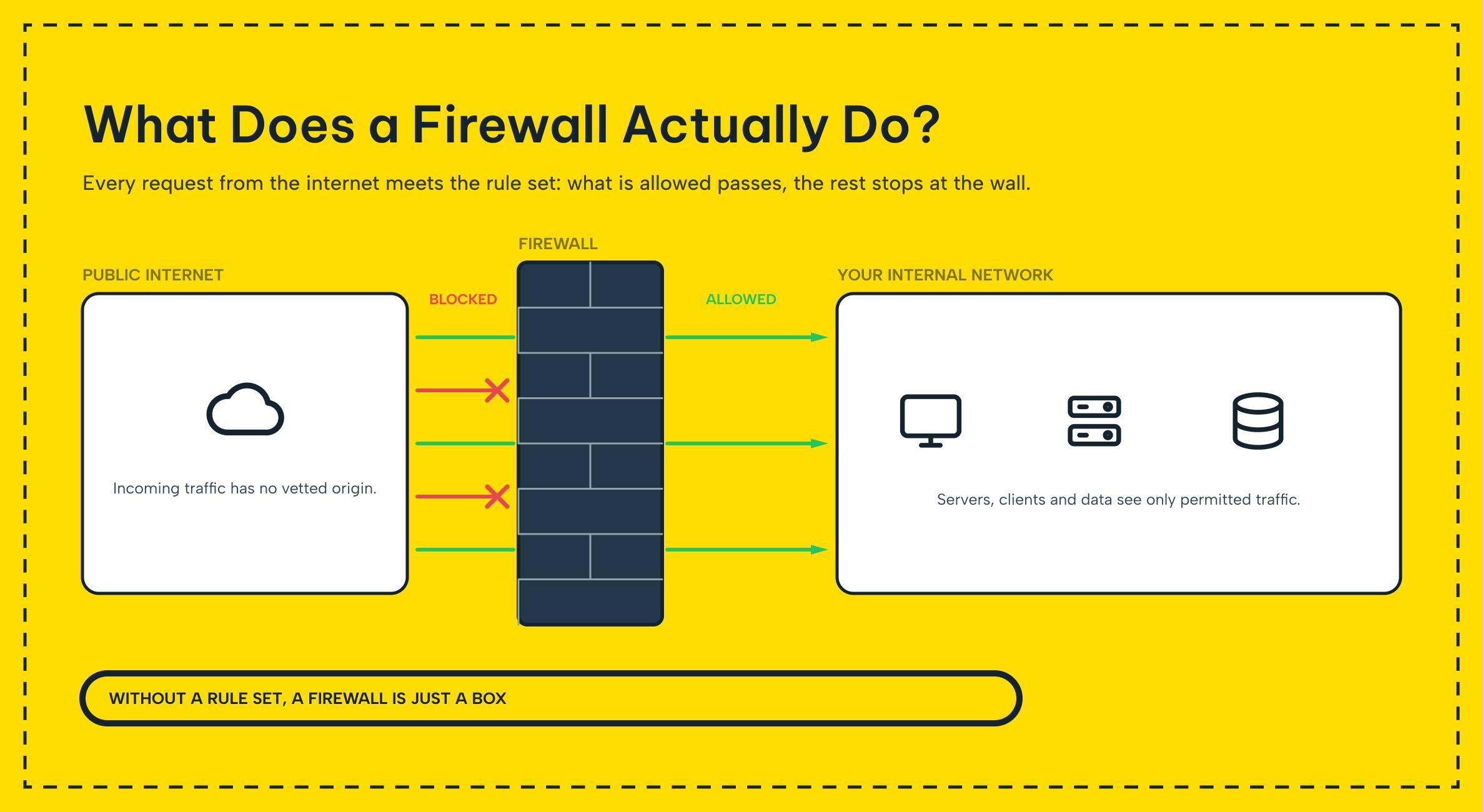
A firewall is a network security system that inspects data packets moving in and out of your network. It then decides what gets through, based on a defined set of security rules. That decision engine relies on two mechanisms working together: access control and traffic filtering. Access control decides which users and devices can reach a resource, and filtering inspects the traffic that follows.
A packet filtering firewall is the most basic implementation of that idea. It permits or blocks incoming and outgoing network traffic based on its rule set. The rules match on the source and destination IP address, port and protocol.
Stateful firewalls track the full context of a connection, not each packet in isolation. Building on that, they can tell a legitimate reply on an already-open session from an unsolicited connection attempt.
The next step up brings deep packet inspection and application awareness into the picture. This broader category is what the industry calls next generation firewalls NGFW. It can recognize a specific application inside otherwise ordinary-looking traffic rather than just checking a port number.
A related but distinct category, the web application firewall or WAF, protects web applications specifically. It screens for attacks such as SQL injection instead of filtering general network traffic.
Modern firewalls include logging, alerting and integration with a wider security stack on top of all of this. Taken together, these are the main types of firewall a growing business will run into. Each new generation has layered more intelligence on top of the last. Even so, none of them replaces the basic packet-filtering idea entirely.
Network firewalls rarely work in isolation any more. The network in question may belong to a two-person shop or a large enterprise. Either way, its job stays the same: watch incoming and outgoing traffic and keep data moving safely.
What Is a Managed Firewall Service?
A managed firewall service means an outside team handles the setup, configuration, monitoring and ongoing updates of that system instead of your own staff carrying the load. The provider runs the underlying devices and software around the clock, so protection does not depend on one in-house employee remembering to check logs or renew a certificate before it expires.
Running a firewall internally is entirely possible, and plenty of larger companies do exactly that. It just demands real expertise and continuous attention: someone has to track new threats, translate them into rule changes, and keep watching for the moment those rules stop matching how the business actually operates. A managed firewall service exists for the businesses that would rather hand that ongoing responsibility to a specialized team than build it from scratch.
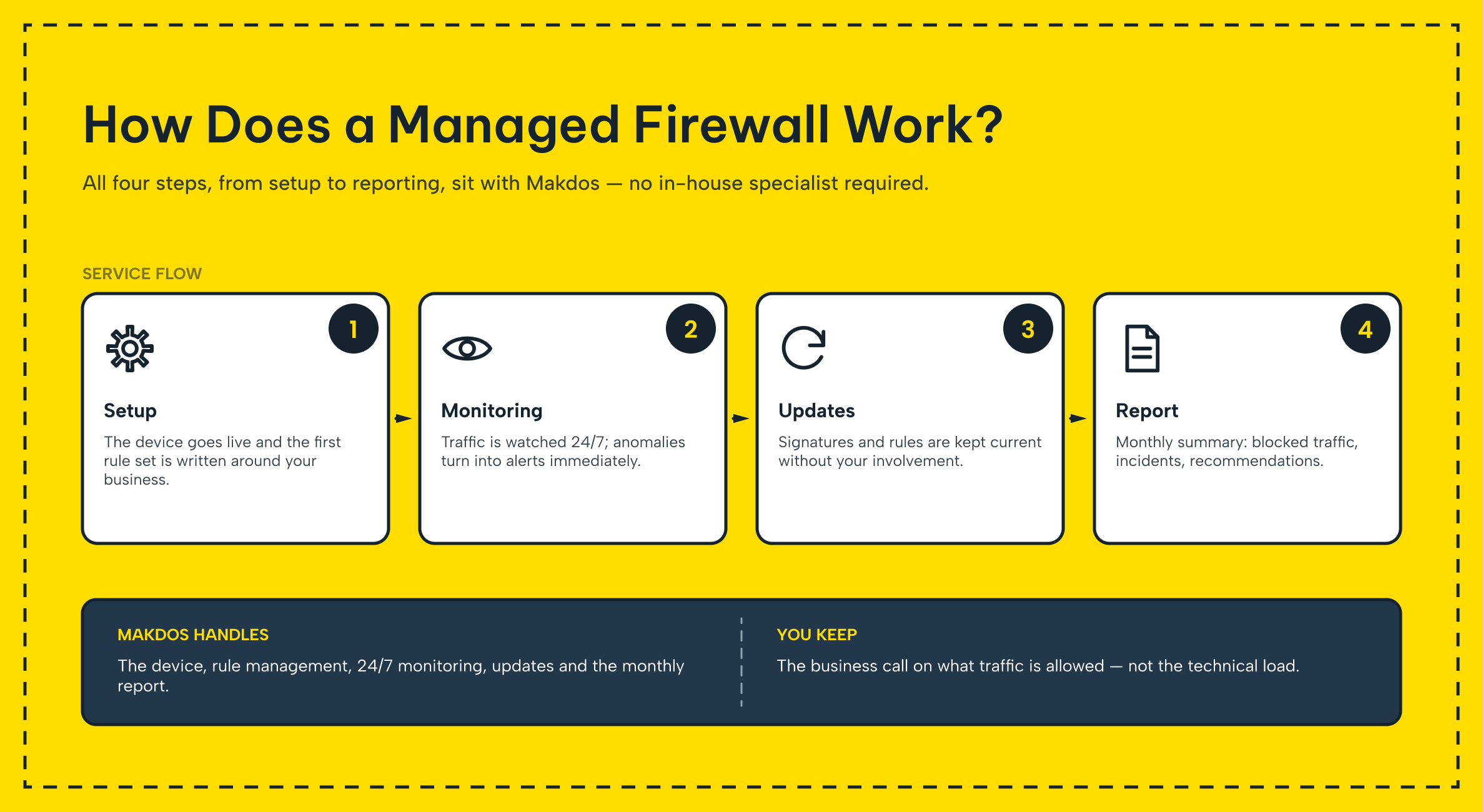
As an example of what that looks like in practice, a managed provider typically ships a starting rule set built around common patterns, web traffic and SSL traffic open to all users, database access restricted to the internal network only, and then customizes it as the business's actual needs come into focus.
What Does a Managed Firewall Service Actually Include?
A managed firewall service typically bundles 24/7 monitoring, rule configuration and updates, threat detection and response, and regular reporting into one subscription. Instead of buying hardware and staffing a security team, a business pays a provider to run, tune and defend it on its behalf around the clock.
The Real Advantages of a Managed Firewall Service
Once the basic model is clear, the advantages follow directly from handing that ongoing work to people who do it full time.
Expert Support and 24/7 Monitoring
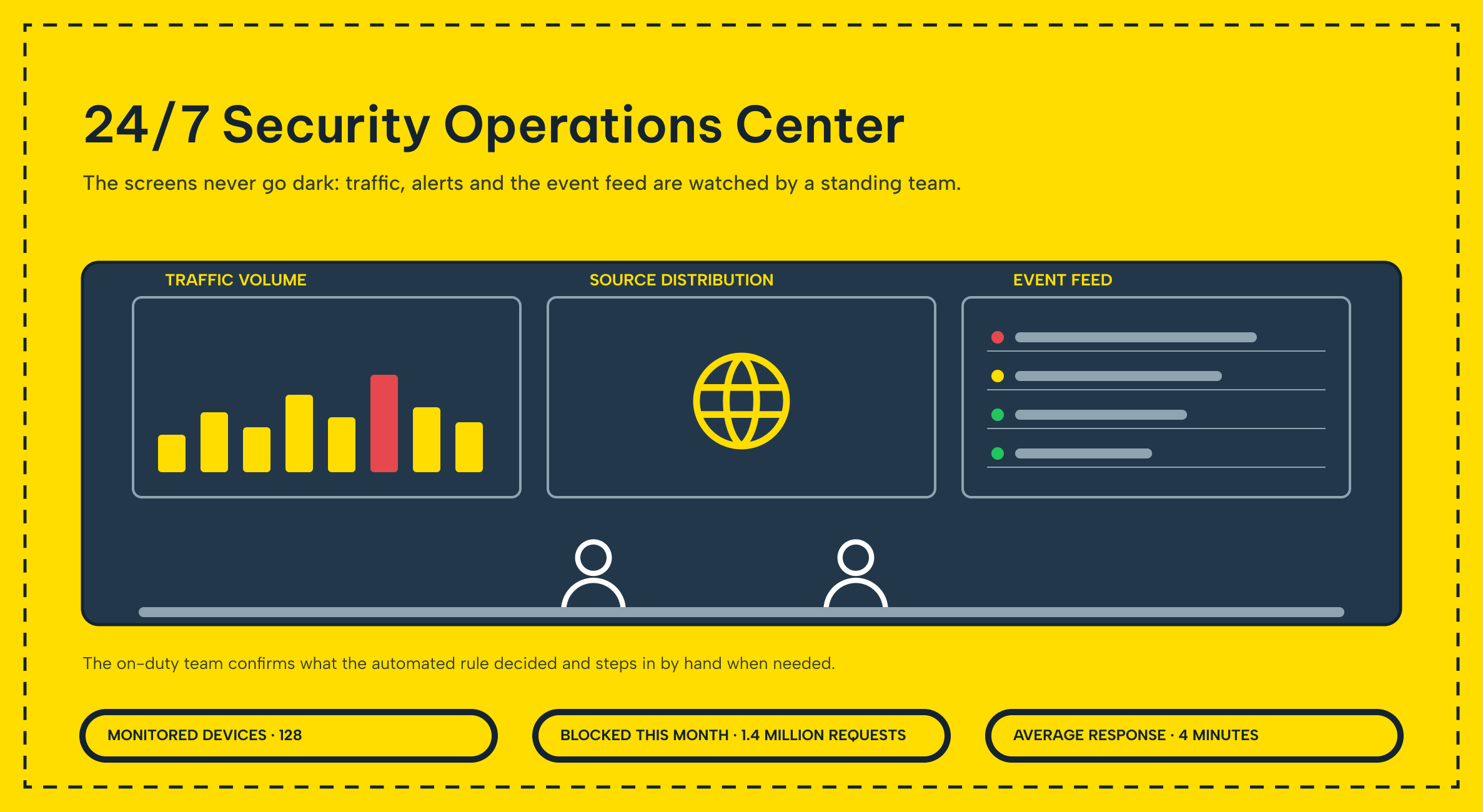
Network security sits in the hands of specialists who track the newest attack patterns as their full-time job, not as one item on a longer IT to-do list. That team keeps the firewall's rule base current and watches traffic around the clock, which means an unusual spike or a suspicious login attempt gets a response in minutes rather than whenever someone happens to check the logs next.
Cost Savings and Zero Hardware Investment
Building an equivalent setup in-house means buying appliances, licensing software and either training or hiring staff who can run it properly. A managed firewall service replaces that capital outlay with a predictable subscription, so a growing business gets professional-grade protection without sinking money into hardware that will need replacing again in a few years.
Customizable Rules Without the Management Burden
Every business has a different network layout and a different risk profile, so a one-size rule set rarely fits for long. A good managed provider builds rules around the business's actual traffic patterns and gives administrators a panel to review blocked-attack reports and check their own security posture, without needing to write or debug the underlying rule syntax themselves.
Continuous Updates and Proactive Protection
Threats do not stay still, and neither should a firewall's rule set or firmware. A managed service keeps both current as part of the subscription, closing the gap between a new attack technique appearing and a business's defenses catching up to it, instead of leaving that update cycle to whoever last had time to look at it.
Scalability as Your Network Grows
One sized for ten employees rarely still fits once that company has fifty, a second office and a handful of remote staff. A managed firewall service scales with those changes: new locations, new remote workers and new servers all get folded into the existing policy rather than triggering a redesign from scratch.
Managed Firewall Service vs. Do-It-Yourself: A Side-by-Side Look
None of this means running a firewall in-house is a bad decision on its own; it depends on what a business is set up to support. A useful rule of thumb: once nobody on the team can name the last time the rule set was reviewed, or once managing it eats more than a few hours a month, the balance has usually already tipped toward outsourcing it.
Managed vs. In-House: Which Firewall Approach Fits?
| Factor | In-House Firewall | Managed Firewall Service |
|---|---|---|
| Upfront cost | Hardware and licensing purchased directly | Predictable subscription, no hardware purchase |
| Ongoing management | Handled by internal IT staff | Handled by the provider's security team |
| Monitoring | Depends on internal staff availability | 24/7 monitoring included |
| Expertise required | Must be built or hired in-house | Provided as part of the service |
| Rule updates | Scheduled around internal capacity | Continuous, part of the subscription |
| Scalability | Requires manual redesign as the network grows | Scales with the business as part of the service |
Most growing SMEs land somewhere in the middle at first, running a basic firewall on their own equipment until the management overhead outweighs the cost of outsourcing it, and that is usually the point where a managed service starts to make the stronger case.
Who Should Consider a Managed Firewall Service?
Any organization with an internet connection benefits from some form of firewall, but a managed service tends to make the most sense for a specific kind of business: one running its own online store, processing customer payment data, or supporting remote employees, without a dedicated in-house security team to watch over all of it.
E-commerce companies, accounting and logistics firms, and healthcare and education providers handling sensitive data are common examples, since a breach in any of these sectors carries real regulatory and reputational cost on top of the immediate disruption. This is not only a large-enterprise concern either.
Smaller teams are often an easier target precisely because automated scanning tools do not check company size before probing an open port, and a lean IT team can struggle to keep pace with a threat landscape that never really stops moving. A quick self-check helps here: if a security incident would take days rather than hours to even notice, that gap alone is often reason enough to bring in outside help.
How Makdos Delivers Managed Firewall Protection
At Makdos, managed firewall protection is built around handing network security off entirely rather than layering it on top of a customer's existing workload. Makdos Firewall and Security brings several functions onto one platform: DDoS mitigation, built-in IPS/IDS to track malicious traffic, WAF protection at the application layer, and secure remote access through SSL-VPN.
Our own security team runs and monitors that infrastructure from Makdos's own data center space around the clock, so protection does not depend on any single customer's in-house staff being available at the right moment. For businesses running more than one office, we build a custom rule set for each location and connect sites through secure IPSec VPN links, so the whole organization runs under one consistent security policy instead of a patchwork of separate configurations.
Firewall protection also comes bundled naturally with infrastructure customers already rely on. Anyone using Makdos virtual server rental gets that protection in place from the first day the server goes live, rather than as a separate project to configure afterward. Customers also get a dashboard that shows blocked-attack activity in plain terms, so a business owner without a security background can still see what the protection is actually doing day to day.
Conclusion: Let a Specialist Team Watch Your Firewall
A firewall only protects a business as well as it is configured, monitored and kept current, and that is exactly the ongoing work a managed firewall service is designed to absorb. We have covered how it works, the technology behind that protection, and the concrete advantages, expert support, cost savings, easier management, continuous updates and scalability, that come with handing the work to a specialized provider.
Company size does not change the underlying math: a properly managed firewall is one of the more cost-effective ways to keep a growing network protected without adding headcount of your own.
Ready to move network security off your plate? Talk to the Makdos team about a managed firewall service built around what your business actually runs, or browse the Makdos blog for more guides on network security and infrastructure.