
Whether it runs a website, an online store, or a customer portal, it also loses trust. This guide explains how a DDoS attack works, the main types you are likely to face, and what actually stops one.
Attacks like this are not rare or randomly targeted anymore. Automated tools scan the internet around the clock. Any exposed IP address can become the target of an attack within minutes, no matter the company size. A small e-commerce store during a sales weekend and a global retailer on a normal Tuesday face the exact same threat model.
The good news is that DDoS attacks follow a small number of well-understood patterns, and each pattern has a matching defense. Once you know what to look for, spotting an attack early becomes routine. Routing around it is just part of running infrastructure, not an emergency.
This guide walks through how attacks actually play out and the three broad categories attackers rely on. It also covers the warning signs that appear before a full outage hits. Finally, it lists the practical steps that keep small businesses, e-commerce teams, and larger brands online. It also covers how Makdos builds DDoS protection into its hosting and server infrastructure by default.
What Is a DDoS Attack, Exactly?
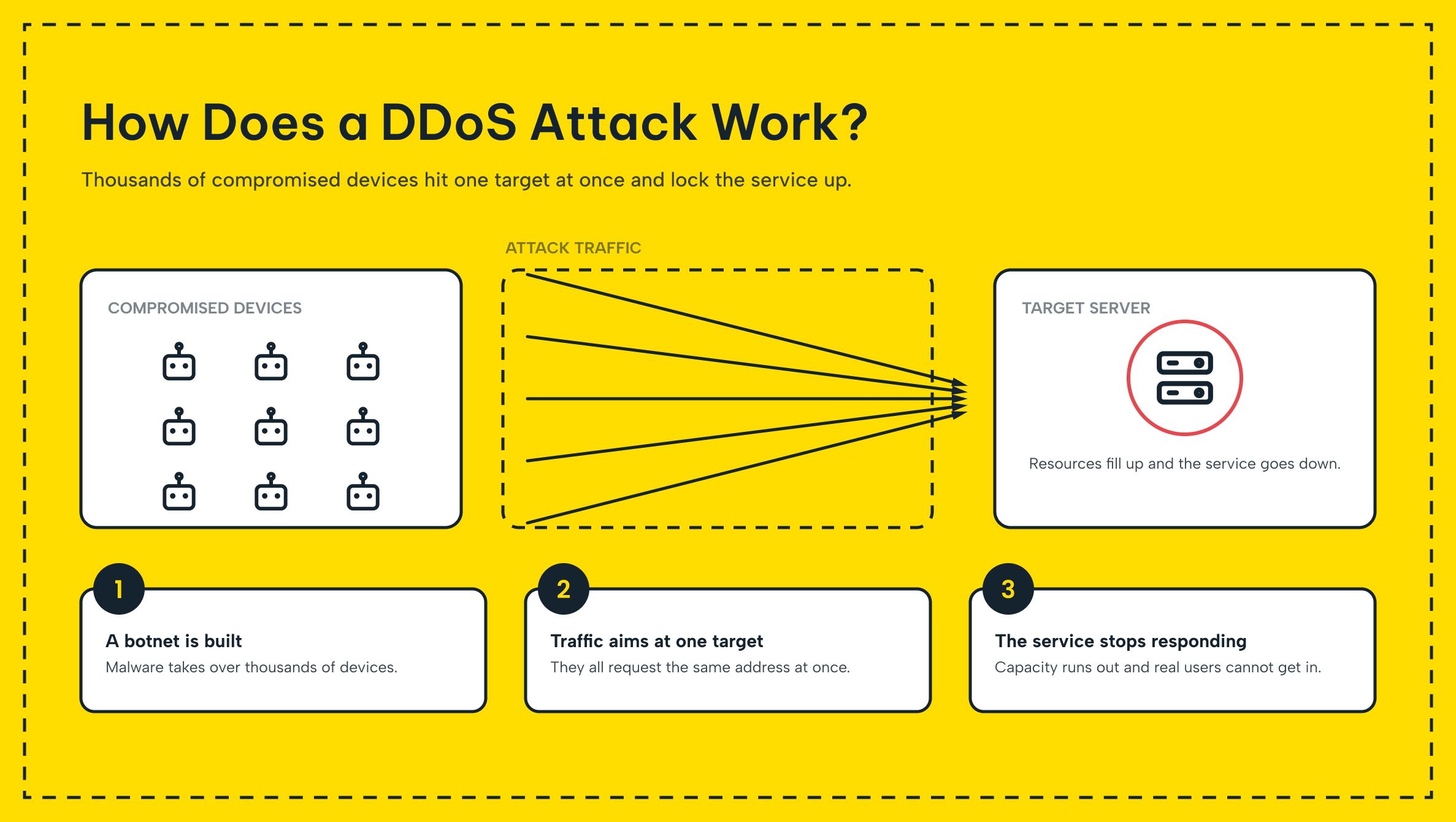
DDoS stands for distributed denial of service. A DDoS attack is different from a single hacker trying to break into one system. It overwhelms a target with sheer volume, using a network of compromised devices called a botnet.
Attackers target whichever resource will fail fastest: your internet bandwidth, your server's connection table, or the application itself. Once that resource runs out, real visitors cannot get through. The service looks down even though no one actually broke into it.
The "distributed" part matters. Traffic arrives from thousands of different sources at once, often spread across dozens of countries. This makes it far harder to block than an attack coming from a single IP address.
A denial of service DDoS attack succeeds when your infrastructure spends more resources fighting off fake requests. It then has far too few resources left to serve real ones.
The Three Main Types of DDoS Attacks
Security teams generally group DDoS activity into three categories. Knowing which one you are facing changes how you respond.
Volumetric Attacks
Volumetric attacks aim straight at your bandwidth. A flood of UDP or ICMP packets pours in, often at terabits of data per second. It saturates your internet connection until nothing else can get through, malicious or otherwise.
This type of attack is easy to spot because the numbers are so large. Stopping it usually requires your provider's help, since no single server can absorb that much traffic by itself.
Protocol Attacks
Protocol attacks target the way servers and networking equipment handle connections rather than raw bandwidth. A SYN flood is the classic example. It opens huge numbers of half-finished TCP connections and never completes them.
The server's connection table fills up, and it can no longer accept new, legitimate traffic. Security teams measure these attacks in packets per second rather than bandwidth. A well-tuned firewall catches many of them before they do real damage.
Application Layer Attacks
Application layer attacks are the most surgical of the three. An HTTP flood sends a huge number of ordinary-looking HTTP requests straight at your web application. Instead of drowning the network, it mimics real visitors closely enough that basic filters wave them through.
Each request looks legitimate on its own, which makes this DDoS attack deceptive. That is why it is often the hardest type to catch early. It usually brings a web server or database to its knees during a longer campaign.
Volumetric vs. Protocol vs. Application Layer DDoS Attacks
| Attack Type | What It Targets | Common Method | Typical First Response |
|---|---|---|---|
| Volumetric | Internet bandwidth | UDP / ICMP flood | Upstream scrubbing, Anycast routing |
| Protocol | Connection tables, network hardware | SYN flood | Firewall rules, connection limits |
| Application Layer | Web application, server resources | HTTP flood | WAF, rate limiting, behavior analysis |
In practice, a serious DDoS defense combines all three responses at once. A real-world attack often blends more than one technique to get past whatever defense goes up first.
Warning Signs Your Business Is Under Attack
A DDoS attack rarely announces itself directly, but it leaves a consistent trail. Watch for:
- A sudden, unexplained slowdown across your website or app, even though nothing changed on your end.
- A spike in traffic from a narrow set of IP addresses is suspicious. So is traffic from a single geographic region that does not match your usual customer base.
- CPU and memory usage climbing sharply on your servers with no matching rise in real orders, logins, or page views.
- A wave of 503 or 504 errors, meaning your server is timing out under load instead of serving pages normally.
None of these signs is proof on its own, since a viral social post or a botched deployment can look similar from the outside. Together, though, they form the pattern every affected business recognizes after the fact. That is exactly why continuous monitoring matters more than a single alert.
Why SMEs and E-Commerce Sites Are Common Targets
Larger enterprises get more headlines when they go down, but smaller businesses are frequently easier targets. Automated attack tools do not check company size; they will probe any open port they find. Small e-commerce stores and regional service providers run on thinner security budgets than firms with dedicated teams.
For an online store, a few hours of downtime during a promotion can cost more in lost sales. That is more than a year of DDoS protection would have cost. For a marketing agency or a SaaS provider serving other businesses, an outage does not just cost you traffic. It puts your own customers' trust on the line, and that reputational cost tends to outlast the attack itself.
That is exactly why DDoS protection belongs in the same conversation as backups and SSL certificates. It is a basic cost of doing business online, not an optional extra reserved for large enterprises.
How to Protect Your Company From a DDoS Attack
There is no single switch that makes DDoS risk disappear. A handful of layered measures covers most of what a growing business actually needs.
Start with your firewall. A properly configured firewall filters out obviously malicious traffic before it reaches your servers. Rules like IP blocking or geographic restrictions cut off entire categories of unwanted traffic in one step.
Add traffic analysis on top of that. Load balancers spread incoming connections across multiple servers instead of relying on one. Anycast routing automatically sends traffic to the nearest healthy location; a regional flood cannot take down your operation.
Rate limiting then caps how many requests a single source can send in a given window. It keeps legitimate traffic flowing while throttling a flood of requests from one source at the door.
For anything beyond a small-scale nuisance, a professional DDoS protection service is worth the cost. Specialist providers separate legitimate traffic from botnet traffic at a scale no single company's servers can match. They sit in the same category as Cloudflare's network edge offering, addressing the same problem. They absorb volumetric floods before those floods can ever reach your infrastructure.
How Makdos Protects Your Infrastructure Against DDoS Attacks
At Makdos, DDoS protection is not an add-on you have to remember to switch on. It ships as a standard part of our server and hosting infrastructure. Each of our three data centers provides at least 20 Gbps of uplink capacity. This gives us the headroom to absorb large volumetric floods before they ever reach a customer's servers.
Makdos Firewall and Security sits in front of that capacity, combining real-time traffic monitoring with automated mitigation, so a sudden spike triggers a response in seconds rather than waiting on a support ticket. IPS/IDS detection and WAF rules work alongside it, screening out protocol-level abuse. They also stop application layer attacks before these reach your application.
Our dedicated servers ship with this same DDoS protection built in as standard, alongside NVMe storage and round-the-clock technical support, so businesses that need dedicated hardware are not left to bolt security on separately.
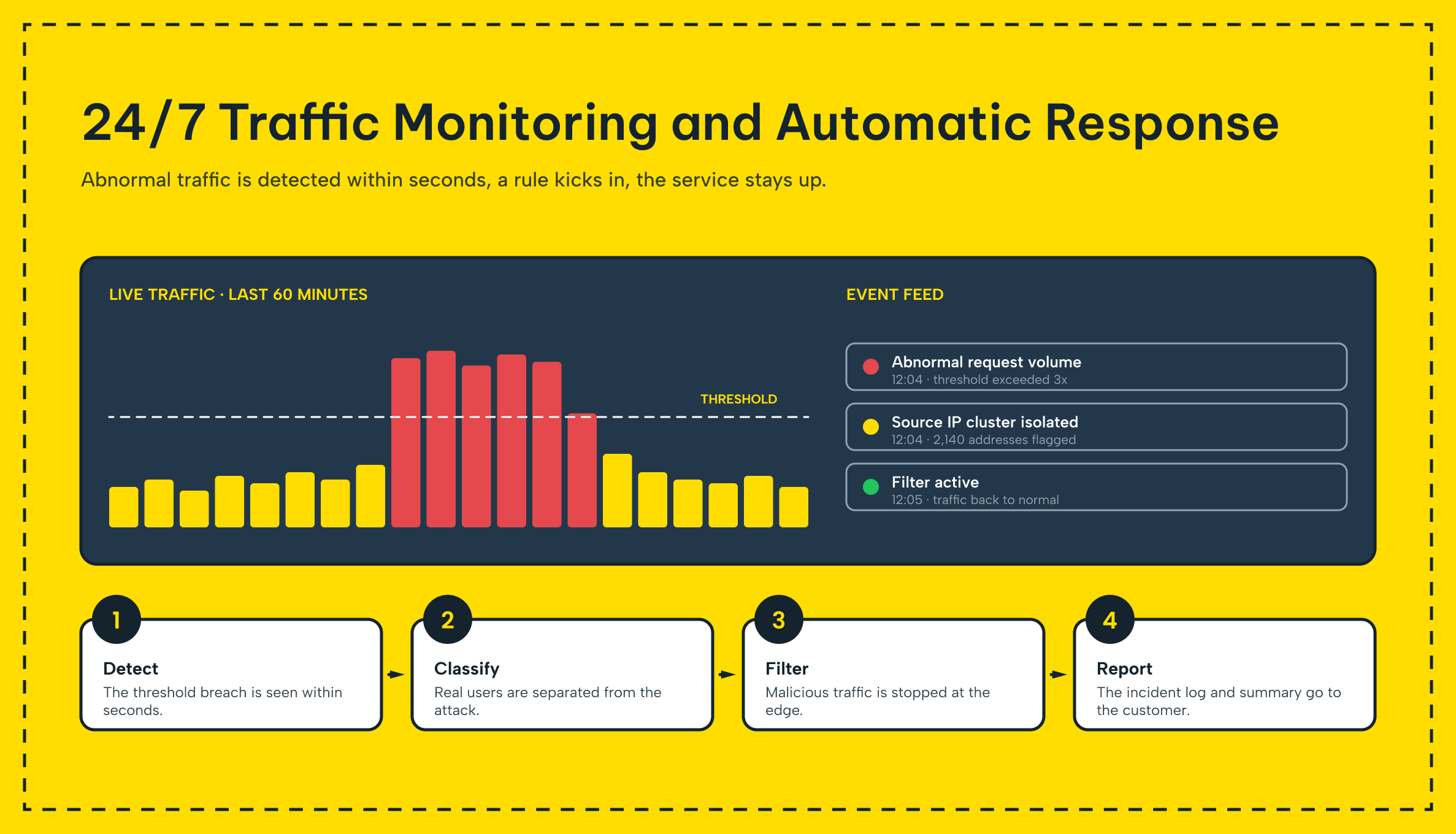
Our own control panel gives customers direct visibility into their protection status. It also lets them adjust settings themselves, skipping the support queue when traffic patterns shift. Continuous monitoring from our own data centers pairs with that combination. It gives your business a defense that scales with you rather than a one-size-fits-all filter.
Common Mistakes That Make an Attack Worse
Even businesses that plan for DDoS risk tend to trip over the same few mistakes.
Reacting too late is the most common one. Waiting until a site has already gone down to start investigating costs precious minutes. A faster response would have saved those minutes, but customers have already noticed.
Misrouting traffic during an incident is another. Panicked changes to DNS or routing can extend an outage instead of shortening it. This happens when they lack a clear plan, especially if they conflict with mitigation already running upstream.
Overly strict firewall rules cut the other way. Such an aggressive lockdown blocks real customers too and just trades one outage for another. It usually takes longer to notice, because the traffic drop looks intentional at first.
Conclusion: Plan for DDoS Before You Need To
A DDoS attack does not care how big your business is, only whether your infrastructure can absorb more traffic than it sends your way. We have covered how these attacks work and the three main categories attackers rely on. Layered defenses, from firewall rules to a dedicated protection service, keep a flood from becoming an outage.
So what should you actually do next? If you cannot say with confidence how your current setup would hold up under a serious flood, that is the gap to close first. Review your firewall rules, uplink capacity, and whether a real mitigation service sits in front of your servers. This review usually surfaces the biggest risks fast.
Every business that connects to the internet is a potential target. The cost of preparing is consistently lower than the cost of an outage during your busiest week. Getting DDoS protection right is one of the most basic steps you can take to keep your infrastructure, and your revenue, online.
Ready to see where your infrastructure stands? Talk to the Makdos team about building DDoS protection into your servers from day one.